Can You State the Terms That Describe How Art Might Be Defined?
Mark Rothko, an American artist who described himself equally an "abstract painter", one time said well-nigh fine art that he was not the kind of person interested in the relationship of form, color or similars. He didn't define himself as an abstractionist, but rather as a person interested but in expressing basic human being emotions such as doom, tragedy, ecstasy and then on. This was one person'south vision of art, simply what do we mean by art today? Why is defining the concept and then difficult?
This commodity is an exploration of the meaning of art and an attempt to understand the relationship between art and artists, with some useful insights via interviews with both traditional and digital artists.
Farther Reading on SmashingMag:
- Popular Art Is Alive: Classics and Modern Artworks
- Milton Glaser on Fine art & Design
- Viii Inspiring Stories Of ASCII Art
- Modern Art Movements To Inspire Your Logo Design
- Icons Of Digital Blueprint
one. About Art - What Is Information technology?
This question pops upward often, and with many answers. Many argue that art cannot be defined. We could go virtually this in several ways. Fine art is often considered the process or production of deliberately arranging elements in a fashion that appeals to the senses or emotions. Information technology encompasses a diverse range of human activities, creations and ways of expression, including music, literature, film, sculpture and paintings. The meaning of fine art is explored in a branch of philosophy known as aesthetics. At least, that'southward what Wikipedia claims.
More after bound! Go on reading below ↓
Art is generally understood every bit any activity or product done by people with a communicative or aesthetic purpose—something that expresses an idea, an emotion or, more generally, a earth view.
It is a component of culture, reflecting economic and social substrates in its design. It transmits ideas and values inherent in every civilization across space and time. Its role changes through fourth dimension, acquiring more than of an aesthetic component here and a socio-educational function at that place.
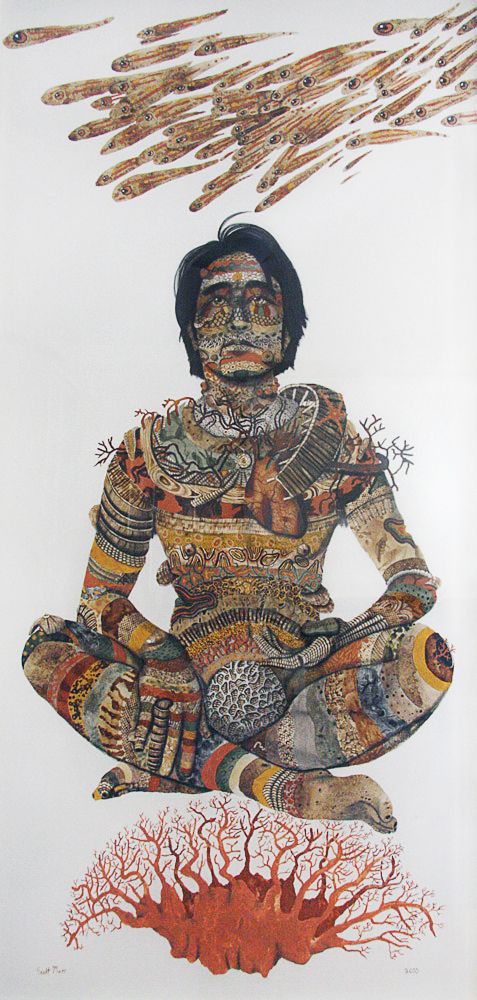
Everything we've said so far has elements of truth but is mainly stance. Co-ordinate to Wikipedia, "Fine art historians and philosophers of art take long had classificatory disputes about art regarding whether a particular cultural form or piece of work should be classified as art."
The definition of art is open, subjective, debatable. In that location is no agreement among historians and artists, which is why we're left with and so many definitions of fine art. The concept itself has changed over centuries.
The very notion of art continues today to stir controversy, beingness so open to multiple interpretations. Information technology tin can be taken only to mean any human activity, or any set of rules needed to develop an activity. This would generalize the concept beyond what is normally understood as the fine arts, now broadened to encompass academic areas. The discussion has many other colloquial uses, too.
In this article, we hateful fine art equally a form of human being expression of a artistic nature.
2. The Evolution Of The Concept Of Art
While the definition of art has changed over the years, the field of fine art history has developed to allow the states to categorize changes in art over fourth dimension and to better understand how art shapes and is shaped by the creative impulses of artists.
Having a solid grasp of art history, then, is important. I spoke with Alexander Daniloff and Jonathan Ball virtually the concept of art through history and about whether tracing a line through traditional and contemporary art is possible.
Alexander Daniloff is a Russian artist who lives and works in Italy. His focus is painting, although he has worked in several media. Lately, he has worked on children's illustrations. He has participated in various events and illustration competitions and has illustrated three books. He has held numerous individual and group exhibitions in Italia, Russia, Kingdom of the netherlands, Kingdom of spain, Finland and the US.
Jonathan Ball is the creative behind Poked Studio, an innovative visitor committed to developing creative visual solutions. That's non all: among its services, Poked Studio offers illustration; Spider web, graphic and blog design; three-D rendering and visualization; move graphics; children's book illustration; Flash websites; and games.
Question: Can we trace a line from traditional to contemporary art?
Alexander Daniloff: I don't call back we tin can say anything without falling into controversy, fifty-fifty me. I have a traditional view and prefer artwork that speaks for the artist or flow. I can't explain what gimmicky art is, or at least what information technology'southward meant to be. Aye, you tin trace a line from traditional to contemporary art, only not a directly ane. Peradventure information technology is a parabola that goes up so downwards, or a spiral. Nosotros don't know. All we can say is that the art market has developed, which affects the art itself. With what we call contemporary art, words and explanations are e'er worth more.
Visual arts take been transformed by articles and critical essays; meanwhile, the works themselves accept go mute. In the theater, the curators and critics have taken upwardly the front row. This is my view on the difference between gimmicky and traditional art.
I personally prefer art measured in human dimensions: art that whispers and doesn't shout, art that covers me and makes me fly and does not trounce. Just I must confess, some of these modern things attract me; for instance, mural painting (graffiti) and abstract things.

Jonathan Brawl: Aye, most definitely [nosotros can draw a line from traditional to contemporary fine art]. Many of the same techniques are used, but in slightly unlike means and with different tools. The same principles apply, however you create art.
I run into a line peculiarly running through the stylized form of Japanese art such equally Hokusai and contemporary stylized graphic illustration.
Question: Compared to the evolution of traditional art, how would you draw the development of digital (or new media) art?
Jonathan Ball: Digital art has evidently adult much more quickly than the thousands of years of paw-crafted techniques. A whole generation has been brought up on "Photoshop" and other tools, whereas earlier generations used pen and pencil.
Still, I believe that digital art is even so in its infancy. Despite what seems an enormous amount of progress in reckoner hardware, general calculating and even the computing available to virtually design studios is just not fast enough to easily reproduce art on the calibration and level of detail possible with traditional media. Go to whatsoever national gallery, and you volition see works on an enormous scale. Try reproducing a 10-foot canvass with the resolution of a hand-painted work of art in a iii-D programme, and you'll find it can't cope. In fact, most programs will struggle to return a detailed motion picture at, say, 300 DPI at just A4 size.
While a painting may appear to be only splotches and blobs, when you become upwards to it close, the patterns are beautiful by themselves, full of colour, intensity, saturation and texture. Go close to digital art or a Tv screen and yous'll meet a mess of distortion and artifacts.
Once screen resolution is on par with printed media, and once computer applied science allows us to easily create large, highly detailed work at speed, and so digital will accept caught upwardly to traditional media.
Most digital art of the early-21st century is designed to exist viewed on depression-resolution devices. Much of this art will be obsolete when higher-resolution screens and devices are developed over the adjacent century. And much that has been stored only on hard drives will be lost forever as drives neglect and websites close or are redeveloped.
I find it a shame that and then much not bad piece of work is reproduced at such a limited resolution and scale and not stored in a manner that keeps information technology rubber for future generations.

Question: Tell united states about art and your favourite fine art move.
Jonathan Brawl: Difficult, because I like so many styles. Only I discover that if I'm in an art gallery, I love contemporary painting because it holds so many surprises and is less predicable than previous eras.
I love quirky gimmicky illustration, particularly low-brow art forms and gothic-mythology mixtures.
3. Aesthetics In Digital Art
Moving into the mid-20th century, the conceptual transformations that arose from new approaches to fine art led to a crisis of aesthetics, as was manifested in new art media.

While borrowing many of the conventions of traditional media, digital fine art can depict upon aesthetics from many other fields. But diverse criticisms have been fabricated against it: for example, given the variety of tools at their disposal, how much effort do digital artists really have to put into their work?
I asked January Willem Wennekes, also known equally Zeptonn, for his stance on this. He is a freelancer who specializes in illustrative design and art direction, with a focus on eco-friendly and environmental projects.
January Willem Wennekes: The question seems a bit cryptic. On the one manus, in that location seems to exist a question about the attempt required to create digital art. That is, some people may call back that using digital media to create fine art is easier than using traditional media. On the other mitt, at that place seems to be a question of whether digital art is an fine art course in itself (or mayhap at all?).
With respect to the first question, I think that working with digital media (mostly the calculator, mouse, Wacom, scanner, software, etc.) does not have to differ from creating art in other media. The computer and all the tools generated past the software are however what they are: tools! You have to master those tools but every bit yous have to main any other tools. For example, if you do not empathize how lite works, you won't be able to create artwork with right lighting, so on. If you don't know how the pen tool works in Illustrator, then y'all won't be able to create practiced artwork, just like a traditional artist who doesn't know how to apply a pencil. You however have to chief color theory and all the other things that are essential to creating a good or stunning piece of art. In that sense, it doesn't matter whether information technology is a painting or a print. Simply put, you take to main all the tools and theory, just as yous had to master them before. And the better you chief them, the meliorate your artwork can be.

January Willem Wennekes: Now, one can wonder whether digital art is a distinct fine art form. This is a difficult question and not piece of cake to answer. I think the departure here is that "digital fine art" is more of a group term than only one art form. There are many types of digital art: some wait a lot like paintings, some look like photographs, some await like drawings, while others appear quite new and unique (due east.g. computer generated artwork). So in a sense, digital art consists of both overlapping and new kinds of art.
Photography was once viewed as a competitor to portrait painting, but in the end it became its own art grade, with many directions and fields of involvement. In result, painting benefitted from the rise of photography, and each added to the other and renewed interest in art in full general. Nowadays, we don't view photography every bit a competitor to painting; we come across them equally unlike media, with different benefits and drawbacks. I think the same holds for newer digital fine art forms.

4. Art Equally We Know It Today
The 20th century was a turning point in our conception of art, which is mainly why gimmicky artists frequently achieve for new concepts, break with tradition and reject archetype notions of beauty. All these factors accept given nascence to abstruse art. The artist no longer tries to reflect reality, just rather tries to requite expression to their inner world and feelings.
The old definitions of fine art have become obsolete. Today, art is an evolving and global concept, open to new interpretation, too fluid to be pinned downwards.
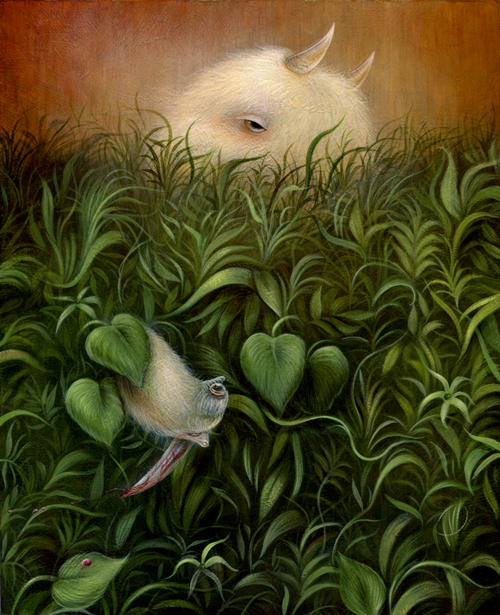
I interviewed Nate Williams and Travis Lampe to explore new elements of contemporary art and to answer the question, what new elements and principles are evident in today's fine art.
Nate Williams, likewise known every bit Alexander Blue, is an creative person, illustrator and designer from the US. He has extensive feel in various facets of the illustration manufacture, and he has a wide diverseness of clients. His illustrations are aimed at both adults and children. He has also worked in the advert world and in publishing, music, fashion, textiles, home decor, merchandising, posters, press and social expression.
Travis Lampe is an illustrator who currently lives and works in Chicago. He worked as an art director in advertisement. Later on a two-twelvemonth stint in Warsaw, he returned to Chicago and tried his hand in the art and illustration scene. He enjoys making fine art and toys, and he has shown in fine galleries throughout the Usa and in Europe.
Question: How much influence does new media have on your work? What is your relationship to digital fine art? Do y'all consider yourself a traditional creative person?
Jonathan Ball: Information technology has a lot of influence. I recall considering of my knowledge of programming, it influences my piece of work. I recall in terms of modular parts and variables.

Travis Lampe: I'thousand a traditional artist—I work in acrylic—but I wouldn't be able to operate without computers. When I design toys, for example, I employ computers to browse and create vector art from my original paintings. I don't create digital art in and of itself, though. Purely digital work can be beautiful, simply for me there is value in having a tangible and unique production, equally opposed to a ready of data.
No dubiety, though, I've been influenced in my traditional art by being exposed to ideas that I've discovered on the Cyberspace. It's a peachy place to find old-timey cartoons, for case.
Question: Travis, if the purpose of art was once to create dazzler and to imitate nature, today the concept has evolved dynamically and is constantly changing. In your stance, how has the Internet and new ways of communicating influenced the evolution of visual arts, its conceptual bounds and its concrete execution?
Travis Lampe: The Cyberspace about influences the evolution of art simply past exposing more than people to more than art. Unfortunately, a lot of it is really, really crappy, as you would expect. Anyone with a ballpoint pen and digital camera tin post their art for the world to see. And that'due south okay. I think the cream only naturally rises to the top. Ideas are still what'south important, far more than so than technical skill, and the Internet hasn't changed that at all. I've seen a lot of ballpoint pen art that I really like.
As far equally concrete execution goes, information technology'southward evolved the way it ever has: as soon equally a new medium arrives, there's a scramble to use information technology in new and creative ways. I don't know that the Internet has afflicted the concrete execution of art so much as computers themselves have. It's just fabricated information technology easier to disseminate.

More than advice is great for PR and in that way is a great help to artists. And more communication should equal more than ideas bouncing around, which ideally should result in better conceptual thinking. But most of the "communication" is fluff. And I think there'due south a threshold beyond which the constant connectedness ceases to be helpful. Artists need some asunder fourth dimension for the artistic ideas to coalesce. Successful artists are the ones who are disciplined and able to rest all of this, I approximate.
Question: Would you say that fine art and the new, social Web have a connection? Are social media a viable way to amend artistic communities?
Jonathan Ball: Of grade. Art has a connection to anything in our environment that influences its creators. As far as social media goes, I think being able to communicate better is ever an improvement.
Travis Lampe: Social media is smashing for sharing results; it's immune me to connect with and come across the work of other artists who I adore on a constant ground. And information technology makes working long hours in a basement a bit less of a lonely enterprise when y'all can bear witness the world what you've done the moment you've finished. On the other hand, social media are a constant lark. When I want to get work done, I disconnect. And then I love it and hate it equally.
Visual arts comprise many forms of art—painting, drawing, sculpture, music, literature and performance art being the nigh widely recognized. Nonetheless, with the technological revolution, others forms accept emerged.

So, what exactly is the relationship between these new forms of expression and contemporary artists? Max Kostenko and Pine Lamanna kindly answered my questions, giving usa insight into the topic.
Max Kostenko is a Russian illustrator. He specializes in 3-D digital analogy and character design. He works every bit a freelancer for many Russian studios and agencies worldwide, such as Kotetkat and Lemonade.
Pino Lamanna, also known as SchakalWal, is an illustrator and graphic designer from Germany who specializes in corporate design, character design and typography.
Question: Please introduce yourself and your work. How did you get started in the field?
Max Kostenko: My name is Max Kostenko. I'm 23 years old, and I am an creative person and illustrator from Moscow. I have been doing illustrations for nearly one year. Before, I worked for three years equally a Web designer in diverse Moscow Web studios.
Pino Lamanna: Hi. My proper name is Pino Lamanna. I am a 27-year-old half-Italian, half-German digital creative person living and working in the city of Wuppertal, in Germany.
I currently work as a freelance designer, specializing in unique branding, handmade typography and character pattern. Most of my piece of work is highly influenced by graffiti and street art, old-school cartoons and the music I listen to. My aim is to create stylish, unique and useful designs with an urban twist.
I took my first steps as a designer equally a trivial child, drawing comic strips with my own superheroes. Later, in my teenage years, I became interested in the graffiti and street fine art movement.
The offset thing that attracted me to digital fine art was photo manipulation. Through that, I was introduced to Adobe Photoshop and several digital art communities. Later, I switched my focus to illustration, branding and typography, which I think suits me all-time.
Question: Tell us a bit almost your artwork. What software practice you employ? How difficult was it for yous to learn?
Max Kostenko: In my piece of work, I use simply Photoshop. I started studying it when I wanted to start working as a Web designer. Merely as years passed, I understood what I really wanted to work on, because I constitute the task of designer ho-hum, so I started drawing some silly picayune men; that is, I tried to understand many of the principles by drawing them. In Photoshop, I do not use many tools to make my work look artistic—I simply choose my normal round brush and starting time drawing.

Pino Lamanna: Even though for the kind of work I specialize in, working in Illustrator or other vector tools would be mutual, I create about of my work in Photoshop. That might audio foreign, only I can't help it. There isn't much of a difference at all, because Photoshop has vector editing capabilities, also.
One time I am happy with my pattern, I copy and paste to Illustrator to create the final output.
I cannot say that mastering Photoshop was hard, because working in it has always been fun. The very kickoff steps were kind of hard, though. I remember beingness overwhelmed by the gazillion options. It was learning by doing. I did a lot of tutorials, which I found online, to get comfortable with dissimilar techniques and methods.
Learning Illustrator wasn't hard, either, because I was already used to the Adobe interface and I knew a lot of stuff most vector editing from Photoshop. And of course, there are tutorials for Illustrator everywhere.
Question: What is the main inspiration for your pieces? And how has the digital fine art community influenced your work?
Max Kostenko: My inspiration comes in unlike means: sometimes after watching a film, sometimes from something I encounter in the street or on public send. I always look for the work of known artists: it stimulates me to grow and amend my skills. I became acquainted with digital art through the Society of Digital Artists, and the offset thought that came to mind was, "I could never draw like that." But then I gradually drew things like leaves. Still, I've only began to walk the path of the artist and nonetheless have much to learn.
Pino Lamanna: Inspiration tin can come from anything, whether a cloud in the heaven, an quondam movie or a box of sushi. My manner has ever been influenced by urban civilization, music, movies, cartoons, etc. As a matter of fact, the digital art community has influenced my piece of work a lot. Thank you to the Internet, I've gotten to know many interesting people and designers from all over the world, and in the stop those communities have helped define me every bit an artist.
Question: How would you depict your creative procedure? What are some of its most important aspects?
Max Kostenko: The well-nigh important thing is a basic idea, I gauge—a plan. If y'all take one, you tin beginning drawing. Sometimes I get in my head a general sense of the result, then I begin with the big shapes, placing them in a composition. When I've got the result, I start to colour it, the most difficult thing for me. At the end, I complete the last details.
Pino Lamanna: I always take pen and paper by my side, even in my sleeping accommodation. You lot never know when ideas will popular in your mind, and y'all better salvage before you forget.
Brainstorming and sketching are crucial for me. If ideas pop up while working on my computer, I'll usually put bated all the stuff I am doing and endeavour to directly realize that idea in a pattern.

When working for clients, research is very important. Without a detailed brief, finding a blueprint to match the client's needs and expectations can be tricky. Therefore, I ever ask clients to fill out my design questionnaire.
Another important aspect of my artistic process is patience. Often, I find a expert flow and tin't stop working on a particular pattern until I am happy (and wearied). Even so, before publishing, I e'er force myself to wait till the next day. I'll often find things that need to be changed, tweaked or tuned upward, when I am looking at my work with a lilliputian distance.
Question: Accept you always gotten into traditional art? If then, tell us something about that experience.
Max Kostenko: The thing is, I wasn't trained in an art schoolhouse. But since childhood, I have liked drawing and thinking of stories. I've ever fatigued with a uncomplicated pencil. After school, I tried to enter the Automotive Design College but was rejected… even having passed the drawing exams marvellously well.
Pino Lamanna: Every bit mentioned, I was into comic drawing every bit a kid, and I trained hard to create the globe'due south most powerful superheroes and villains. I tin can remember only a single grapheme from these days: Super-Frog. (I know that'due south lame, so don't be hateful!)
Later, I got some experience with graffiti and street art. Never made information technology to the All City Kings, though.
So, I don't have much experience with traditional fine art, because my main focus for the last couple of years has been on digital.
Question: How would you define your relationship to traditional fine art? Who is your favourite artist?
Max Kostenko: I oftentimes visit the Tretyakov Gallery, and I tin can't believe people could depict like that on a canvas centuries ago. I am surprised every time by the talent of classical artists.
I like Russian mural artists. Vasily Polenov and Ivan Shishkin are top in skills for me.
The artist's life is not as simple as it may seem. Continuing out from the oversupply is not easy, which is why self-promotion is essential.
I queried Bob Flynn, Alex Dukal, Jayme McGowan, Chris Piascik and Irma Gruenholz for their thoughts on the art of self-promotion; on how to spread ideas, concepts and a deeper vision of their work; and on the impact of this kind of marketing.
Bob Flynn is a cartoonist who is interested in illustration, comics and animation. He currently resides in Boston, where he works as an animator and game designer for the children'southward media company Fablevision. His work has appeared in publications such as Nickelodeon Mag and Improper Bostonian.
Alex Dukal is an illustrator who was born and raised in Patagonia, Argentina. From a very young historic period, Alex has published comics and illustrations in the legendary Fierro mag.
Back in his home town, he dedicated some years to painting and teaching illustration and comics. After working for some fourth dimension by and large in Web design, Alex decided to get back into illustration. At the moment, he's working mostly on children'south books and creating illustrations for design agencies.
Jayme McGowan is a freelance artist and 3-D illustrator based in Sacramento, California. She works with cut newspaper.
Question: Practise you have a portfolio website? And which social networks are you currently on?
Bob Flynn: I have a website, but I'g very lazy about updating it. And I find I get less traffic there compared to, say, my blog, which is infinitely easier to add together to. A portfolio website is more of a structured presentation, which is great for art directors and people looking to brand a professional assessment of your work. It's often static, and it offers little to no opportunity for 2-way communication. You become little to no interaction with the art customs except for a friendly electronic mail or ii a calendar month. A weblog is dynamic and opens that dialogue. I now think of my website as a hub to assistance straight people where they need to go.
In addition to having a blog (my primary bespeak of communication), I'm currently on Twitter, Facebook, Flickr and, virtually recently, Google Buzz. Is beingness on all of them worth it? Probably. I've plant that you really can't be in too many places—though there is certainly a sanity threshold. A unlike audition traffics each social space (with some overlap), so the way to attain the virtually people is to be everywhere.
Twitter is currently the all-time identify to track people in the industry and to communicate with your peers—but not anybody is there. Facebook is where most anybody else is, although juggling friends, family unit and business is admittedly cumbersome. You lot accept to weed through the ataxia (I'thousand less a fan of its increasingly unwieldy interface), but you tin certainly get traction over there. Flickr is the most straightforward: upload artwork, go out and receive comments. Buzz is new to the game and nonetheless hasn't developed an identity of its own. But it'due south another identify you should probably exist.
I can rails nigh chore leads and connections back to a tweet hither or a comment there. Not to mention great friendships. Simply by spending fourth dimension in these spaces, saying "Hullo" and participating in a positive way, yous really tin can't go wrong.

Alex Dukal: Yep, I have had a portfolio online since 1998, and I currently use Facebook a lot, Twitter not so much. I really similar Flickr. I used Orkut when information technology kickoff came out. I tried Google Fizz and did non like it. Every now so I take a look at Google Wave to see if information technology'll ever plow into something interesting. I have a Netvibes business relationship that I hardly use. I have an account on Dribble. As you tin can encounter, I similar to test new tools.
Jayme McGowan: Yes, I have a website for my portfolio, and pages on Facebook, Flickr and Etsy, and I recently caved and am now on Twitter as well.
Question: Do you write manufactures for your own blog or for other blogs and publications? Would you lot consider either an effective way to become your proper noun out there?
Bob Flynn: I regularly post artwork to my blog, and I accept written a few Flash drawing tutorials. Simply having an online presence is a good outset, but think of the affect you could have by sharing information, ideas and helpful tips. People enjoy reading about process, so document your methodology equally you lot piece of work, and it volition make for more than interesting posts.
I wouldn't be in this just to get my name out, though. If you're all for show and self-promotion, you risk turning people away. Participation is primal: I enjoy reading about what everyone else has to say. There's more than value in that, really.
Alex Dukal: I started writing little news on my website using Grey Thing, an one-time tool for blogging. And so I switched to Textpattern, and finally I separated my portfolio and blog (at present in Blogger) every bit a matter of convenience. In the blog from time to fourth dimension, I'll write an commodity or tutorial. Judging from the feedback I become, I'd consider information technology an effective method of promotion.
Jayme McGowan: I have a blog where I post images of my work in progress and updates on current projects I'm involved in. I apply it to give readers some insight into my process. I retrieve it definitely gets people more involved in my work. Most of the visitors to my main portfolio website were directed there either from my ain blog or from someone who did a post about my work on their weblog. I recall if you go on your blog up to date and post regularly, information technology will exist an invaluable tool for getting your name out there.
Question: What are the challenges of creating a self-promotion strategy? Have you implemented a self-promotion strategy for yourself? Has it worked? If one is starting from scratch, how long does information technology take for a strategy to start working in their favor?
Bob Flynn: To exist honest, I can't say I've ever architected a real strategy. You're talking to a guy who'southward never even sent out a promo card. My arroyo has been to put myself out in that location and encounter what happens. Sort of the like old adage, "Just exist yourself"—that's how you lot stand out from the residue of the pack. I try to update my blog at least one time a calendar week to keep people coming back. Keeping up with your website's stats is a good manner to see what's sticking (i.e. where your traffic's coming from and what your well-nigh popular posts are).
Alex Dukal: Yes, of course, every bit a freelance artist, self-promotion is admittedly necessary. I think the first challenge is having something to say, something to show, a reliable portfolio to support that promotion.
Personally, I placed my bet on a portfolio that shows my best work, something that showcases the illustrations rather than the website interface and that makes it accesible and uncomplicated. And so there'southward the blog, which allows me to maintain other kinds of contact with people: social networks, forums, contacts database, etc. Information technology'due south a big garden; one must water and take care of it every day.
I recollect a strategy of this kind should be thought of in dissimilar phases. And you tin't wait a miracle before vi months (though miracles do happen).

Jayme McGowan: My self-promotion strategy is adequately unproblematic and involves social networks, as I mentioned earlier. When I got started creating a presence online, I came upwardly with a plan past looking at the networks that successful artists who I admired were involved in, and I tried to practice something like. I was fortunate plenty to generate interest in my work early on just by posting photos on Flickr and becoming an active fellow member of the Etsy community. Many people who commission work from me say they found me on one of those 2 websites.
Now I utilise Facebook and Twitter (and my blog, of course) to keep people posted on what I'm up to. Merely to succeed in promoting yourself on any of these networks, you have to be truly interested in making friends and business organization contacts. Y'all can't just scream, "Hey, expect at me!" all the time without giving anything back. I estimate I have a subtler approach to self-promotion: let people know what you're upwards to from time to fourth dimension, and trust that they'll follow y'all if they similar what they come across.
Question: Do you lot regularly submit your work to online galleries? Is that useful for gaining brownie and getting feedback on your work?
Bob Flynn: I created an account on a great website run by Nate Williams called Illustration Mundo a few years dorsum, merely I've never put my work in an online gallery (or paid for annihilation of the sort). I guess I view my blog every bit having that purpose. Flickr is a kind of gallery, though.
Pine Lamanna, also known equally SchakalWal, is an illustrator and graphic designer from Deutschland who specializes in corporate design, character design and typography.
Question: Please introduce yourself and your work. How did you get started in the field?
Max Kostenko: My name is Max Kostenko. I'g 23 years old, and I am an artist and illustrator from Moscow. I have been doing illustrations for near ane year. Before, I worked for three years as a Spider web designer in diverse Moscow Web studios.
Pine Lamanna: Hello. My name is Pino Lamanna. I am a 27-yr-old one-half-Italian, one-half-German digital artist living and working in the city of Wuppertal, in Deutschland.
I currently work as a freelance designer, specializing in unique branding, handmade typography and character blueprint. Most of my work is highly influenced by graffiti and street art, old-school cartoons and the music I listen to. My aim is to create stylish, unique and useful designs with an urban twist.
I took my kickoff steps as a designer as a little kid, drawing comic strips with my ain superheroes. Subsequently, in my teenage years, I became interested in the graffiti and street art movement.
The start thing that attracted me to digital art was photo manipulation. Through that, I was introduced to Adobe Photoshop and several digital fine art communities. Later, I switched my focus to analogy, branding and typography, which I think suits me all-time.
Question: Tell us a bit about your artwork. What software do you lot employ? How hard was information technology for y'all to learn?
Max Kostenko: In my piece of work, I use only Photoshop. I started studying information technology when I wanted to showtime working equally a Spider web designer. But as years passed, I understood what I really wanted to work on, considering I plant the task of designer boring, and then I started drawing some silly footling men; that is, I tried to sympathize many of the principles by drawing them. In Photoshop, I practice non utilize many tools to make my piece of work look artistic—I just choose my normal round brush and start drawing.
Pino Lamanna: Even though for the kind of work I specialize in, working in Illustrator or other vector tools would be mutual, I create nigh of my piece of work in Photoshop. That might sound strange, but I can't help information technology. There isn't much of a departure at all, considering Photoshop has vector editing capabilities, too.
One time I am happy with my design, I copy and paste to Illustrator to create the final output.
I cannot say that mastering Photoshop was hard, because working in it has always been fun. The very kickoff steps were kind of hard, though. I recall being overwhelmed by the gazillion options. It was learning by doing. I did a lot of tutorials, which I found online, to become comfortable with different techniques and methods.
Learning Illustrator wasn't hard, either, because I was already used to the Adobe interface and I knew a lot of stuff about vector editing from Photoshop. And of grade, there are tutorials for Illustrator everywhere.
Question: What is the main inspiration for your pieces? And how has the digital art community influenced your work?
Max Kostenko: My inspiration comes in unlike ways: sometimes after watching a movie, sometimes from something I see in the street or on public send. I always look for the work of known artists: it stimulates me to grow and improve my skills. I became acquainted with digital art through the Gild of Digital Artists, and the beginning thought that came to listen was, "I could never draw like that." But then I gradually drew things like leaves. All the same, I've only began to walk the path of the artist and notwithstanding have much to learn.
Pine Lamanna: Inspiration can come from annihilation, whether a cloud in the heaven, an old movie or a box of sushi. My style has ever been influenced past urban civilization, music, movies, cartoons, etc. As a matter of fact, the digital art community has influenced my work a lot. Thanks to the Cyberspace, I've gotten to know many interesting people and designers from all over the world, and in the end those communities have helped define me equally an creative person.
Question: How would you describe your creative procedure? What are some of its nigh important aspects?
Max Kostenko: The nigh of import thing is a basic idea, I guess—a plan. If you have 1, you tin showtime cartoon. Sometimes I go far my head a general sense of the result, and then I brainstorm with the big shapes, placing them in a composition. When I've got the result, I start to color it, the about hard thing for me. At the end, I complete the terminal details.
Pine Lamanna: I ever have pen and paper by my side, even in my bedroom. You never know when ideas volition popular in your mind, and you better relieve earlier you forget.
Brainstorming and sketching are crucial for me. If ideas popular up while working on my computer, I'll unremarkably put aside all the stuff I am doing and endeavor to directly realize that idea in a design.
When working for clients, research is very important. Without a detailed brief, finding a design to match the client's needs and expectations can be tricky. Therefore, I always ask clients to fill out my design questionnaire.
Another important aspect of my creative process is patience. Often, I detect a adept menstruation and can't stop working on a particular pattern until I am happy (and exhausted). However, before publishing, I always force myself to wait till the next day. I'll often find things that need to exist changed, tweaked or tuned upwardly, when I am looking at my piece of work with a little altitude.
Question: Have you ever gotten into traditional art? If so, tell u.s.a. something about that feel.
Max Kostenko: The thing is, I wasn't trained in an art schoolhouse. Simply since childhood, I have liked cartoon and thinking of stories. I've always drawn with a simple pencil. Afterwards school, I tried to enter the Automotive Design College but was rejected… fifty-fifty having passed the cartoon exams marvellously well.
Pine Lamanna: As mentioned, I was into comic cartoon as a kid, and I trained hard to create the world's most powerful superheroes and villains. I can remember simply a single grapheme from these days: Super-Frog. (I know that'due south lame, so don't be mean!)
Afterward, I got some experience with graffiti and street art. Never made it to the All City Kings, though.
So, I don't have much experience with traditional art, because my principal focus for the last couple of years has been on digital.
Question: How would you lot define your relationship to traditional art? Who is your favourite artist?
Max Kostenko: I often visit the Tretyakov Gallery, and I can't believe people could depict like that on a sail centuries ago. I am surprised every time by the talent of classical artists.
I like Russian landscape artists. Vasily Polenov and Ivan Shishkin are top in skills for me.
The artist's life is non as simple equally it may seem. Standing out from the crowd is not easy, which is why self-promotion is essential.
I queried Bob Flynn, Alex Dukal, Jayme McGowan, Chris Piascik and Irma Gruenholz for their thoughts on the art of self-promotion; on how to spread ideas, concepts and a deeper vision of their work; and on the impact of this kind of marketing.
Bob Flynn is a cartoonist who is interested in illustration, comics and blitheness. He currently resides in Boston, where he works as an animator and game designer for the children's media visitor Fablevision. His work has appeared in publications such as Nickelodeon Mag and Improper Bostonian.
Alex Dukal is an illustrator who was born and raised in Patagonia, Argentina. From a very immature historic period, Alex has published comics and illustrations in the legendary Fierro magazine.
Back in his dwelling house boondocks, he dedicated some years to painting and pedagogy illustration and comics. Afterwards working for some fourth dimension mostly in Web blueprint, Alex decided to become back into illustration. At the moment, he's working mostly on children'southward books and creating illustrations for design agencies.
Jayme McGowan is a freelance creative person and 3-D illustrator based in Sacramento, California. She works with cut paper.
Question: Do you have a portfolio website? And which social networks are you currently on?
Bob Flynn: I accept a website, only I'chiliad very lazy about updating it. And I find I get less traffic in that location compared to, say, my web log, which is infinitely easier to add to. A portfolio website is more than of a structured presentation, which is great for art directors and people looking to make a professional assessment of your piece of work. It's often static, and it offers little to no opportunity for two-fashion advice. You get trivial to no interaction with the art community except for a friendly email or two a month. A blog is dynamic and opens that dialogue. I now think of my website as a hub to help direct people where they need to go.
In improver to having a web log (my principal indicate of communication), I'm currently on Twitter, Facebook, Flickr and, most recently, Google Buzz. Is beingness on all of them worth it? Probably. I've found that you actually can't be in too many places—though there is certainly a sanity threshold. A unlike audition traffics each social space (with some overlap), then the way to reach the most people is to be everywhere.
Twitter is currently the best place to track people in the industry and to communicate with your peers—but not everyone is in that location. Facebook is where virtually everyone else is, although juggling friends, family and concern is admittedly cumbersome. You have to weed through the clutter (I'm less a fan of its increasingly unwieldy interface), merely you can certainly get traction over there. Flickr is the most straightforward: upload artwork, go out and receive comments. Buzz is new to the game and still hasn't adult an identity of its ain. But it'south another place yous should probably be.
I can track most job leads and connections dorsum to a tweet here or a comment there. Not to mention bully friendships. But by spending time in these spaces, saying "Hullo" and participating in a positive way, yous actually tin't go wrong.
Alex Dukal: Yeah, I accept had a portfolio online since 1998, and I currently apply Facebook a lot, Twitter not so much. I really like Flickr. I used Orkut when it first came out. I tried Google Fizz and did not similar it. Every at present and so I take a await at Google Wave to see if it'll ever turn into something interesting. I have a Netvibes account that I inappreciably use. I have an business relationship on Dribble. As you can come across, I like to examination new tools.
Jayme McGowan: Yes, I have a website for my portfolio, and pages on Facebook, Flickr and Etsy, and I recently caved and am now on Twitter likewise.
Question: Do you lot write manufactures for your own blog or for other blogs and publications? Would y'all consider either an effective way to get your name out there?
Bob Flynn: I regularly post artwork to my blog, and I take written a few Flash drawing tutorials. But having an online presence is a good start, but call back of the touch you lot could accept past sharing data, ideas and helpful tips. People enjoy reading about process, so document your methodology as you work, and it volition make for more interesting posts.
I wouldn't be in this only to get my name out, though. If you're all for prove and cocky-promotion, you lot risk turning people away. Participation is central: I relish reading about what everyone else has to say. At that place's more than value in that, actually.
Alex Dukal: I started writing little news on my website using Grey Matter, an old tool for blogging. Then I switched to Textpattern, and finally I separated my portfolio and blog (now in Blogger) as a matter of convenience. In the weblog from fourth dimension to fourth dimension, I'll write an article or tutorial. Judging from the feedback I go, I'd consider it an effective method of promotion.
Jayme McGowan: I accept a blog where I post images of my work in progress and updates on current projects I'm involved in. I use it to give readers some insight into my process. I think information technology definitely gets people more than involved in my work. Most of the visitors to my main portfolio website were directed there either from my own blog or from someone who did a mail service about my work on their blog. I think if y'all go on your blog up to date and post regularly, it will be an invaluable tool for getting your proper name out there.
Question: What are the challenges of creating a self-promotion strategy? Have you implemented a self-promotion strategy for yourself? Has information technology worked? If ane is starting from scratch, how long does it take for a strategy to starting time working in their favor?
Bob Flynn: To be honest, I can't say I've always architected a existent strategy. You're talking to a guy who's never even sent out a promo card. My arroyo has been to put myself out there and come across what happens. Sort of the like old adage, "But be yourself"—that's how you stand out from the rest of the pack. I try to update my blog at least one time a calendar week to keep people coming back. Keeping upwards with your website'south stats is a good way to see what's sticking (i.eastward. where your traffic's coming from and what your nigh popular posts are).
Alex Dukal: Yes, of course, as a freelance creative person, self-promotion is absolutely necessary. I think the first challenge is having something to say, something to prove, a reliable portfolio to support that promotion.
Personally, I placed my bet on a portfolio that shows my all-time work, something that showcases the illustrations rather than the website interface and that makes it accesible and elementary. And then there's the weblog, which allows me to maintain other kinds of contact with people: social networks, forums, contacts database, etc. Information technology's a large garden; one must h2o and accept intendance of it every day.
I recall a strategy of this kind should be thought of in dissimilar phases. And yous tin't look a miracle before six months (though miracles do happen).
Jayme McGowan: My self-promotion strategy is fairly simple and involves social networks, as I mentioned earlier. When I got started creating a presence online, I came up with a plan by looking at the networks that successful artists who I admired were involved in, and I tried to do something like. I was fortunate enough to generate interest in my work early on but by posting photos on Flickr and becoming an active member of the Etsy community. Many people who committee work from me say they found me on one of those 2 websites.
Now I use Facebook and Twitter (and my web log, of course) to keep people posted on what I'm up to. But to succeed in promoting yourself on any of these networks, you have to exist truly interested in making friends and business organization contacts. You tin can't but scream, "Hey, look at me!" all the time without giving annihilation dorsum. I gauge I have a subtler arroyo to cocky-promotion: allow people know what y'all're up to from fourth dimension to time, and trust that they'll follow you if they like what they see.
Question: Exercise you regularly submit your piece of work to online galleries? Is that useful for gaining credibility and getting feedback on your work?
Bob Flynn: I created an business relationship on a great website run by Nate Williams called Illustration Mundo a few years back, but I've never put my work in an online gallery (or paid for anything of the sort). I guess I view my blog equally having that purpose. Flickr is a kind of gallery, though.
Alex Dukal: Not at all to both questions. X years agone, if someone invited you lot to show some of your piece of work in an online gallery, it was cute, flattering. Today, I think we accept to exist careful, because the selection criteria is ofttimes not that great, and i must pay attending to those details besides. If y'all display your work in the wrong place, it could take a negative result. In principle, credibility should come from the work itself.
Jayme McGowan: I take a profile on Illustration Mundo, which is a smashing website that functions mainly as a directory of illustrators, non a gallery per se. Honestly, I don't participate in whatever online galleries. I'm sure that'due south a not bad way to get feedback from your peers, but I don't know that information technology will requite y'all added credibility equally a professional. I can maintain only so many Web pages myself, so I effort to limit them to the ones I get the virtually benefit from, those where I believe art directors and buyers might observe me.

Chris Piascik is a freelance designer and illustrator who is active in the design customs. With vi years of professional experience at award-winning firms in New England, he has had piece of work published in numerous books and publications, including the Logo Lounge serial, Typography Essentials and Lettering: Beyond Calculator Graphics. He currently posts drawings on his website daily.
Irma Gruenholz is a Spanish illustrator who specializes in clay and other materials, allowing her to work in book. Her piece of work is used in books, magazines, advertisements and online marketing.
Question: Are you an agile participant in every social community you accept joined? How much time exercise you lot fix aside to interact in social media? Exercise y'all commit to posting new work and personal updates regularly?
Chris Piascik: I stay agile in quite a few social communities. I admit that I have joined some that I couldn't keep upwardly with though! I don't really schedule time for social networking, although that's probably a skilful idea. Instead, I scatter it throughout the day, whether information technology's browsing Twitter on my iPhone while exporting a large file on my computer or procrastinating the commencement of a new project. Information technology's all about multi-tasking! I think the biggest thing that has helped me with social networking is my daily drawings. I mail service a new drawing Monday to Friday on Flickr, and from there I post it to my personal website, and those updates period to my Twitter and Facebook accounts.

Irma Gruenholz: Yes, I take a blog, and I participate in some social communities, such equally Flickr and Behance. Unfortunately, I don't have much time for a very agile presence. I would similar to devote more fourth dimension because it is a skillful mode to go on up with and meet the work of other artists.
Question: At the moment, which customs is the most valuable for finding job opportunities?
Chris Piascik: I think almost of the networks out in that location have value. I practise call back Flickr works actually well, though. My Flickr folio seems to get the virtually traffic out of all my websites. Flickr is so vast that a lot of people use it for epitome research. I think my daily updates assist my work not get lost.
Irma Gruenholz: Based on personal experience, Behance is a proficient platform for showing your work to fine art directors and art buyers. I've gotten some work through it.
Question: How important is crafting the messages you send out and keeping your website looking professional?
Chris Piascik: I don't conscience myself that often. I call back keeping things honest is a good affair. My work has some personality; much of it has a loose quality—pairing that with a cold or professional Web presence would seem odd. Expanding your social networks requires you lot to be yourself… just every bit long every bit "yourself" is interesting!
Irma Gruenholz: Internet presence is very of import for the artist. It is the all-time style to showroom your work to the remainder of the world. So, proceed your website updated, and make information technology easy to communicate with people who want to follow your piece of work.

Question: How practice you make time for social networks? Are you committed only to websites from which you tin can go some professional benefit?
Chris Piascik: I have completely given up sleep. I really just sprinkle it throughout my day. It's a dainty style to first my 24-hour interval while drinking my coffee or eating some dejeuner. I wouldn't say that I limit myself merely to websites that I benefit from, though my opinion is that all networks help. Visibility is visibility. I employ social networking to stay in touch with friends equally well, so it's non strictly business for me.
Irma Gruenholz: I take footling fourth dimension to devote to social networks, then I prefer to focus on communities related to my profession.
Featured Artists
To grasp the meaning of art and how it has evolved over fourth dimension, I interviewed Alexander Daniloff and Jonathan Brawl. To explore the aesthetics of digital art, I spoke with Jan Willem Wennekes, who touched on some of import points related to the differences between digital artists and other artists and the nature of digital fine art itself.
I besides characteristic Nate Williams and Travis Lampe, in an effort to learn more about their work and their relationship to technology, including digital art tools and social media, and to explore the way the Net influences the development of art.
To ameliorate empathize the human relationship between contemporary artists and new methods and tools for creating fine art, I've interviewed Max Kostenko and Pino Lamanna. I focused on their creative process and professional person experience, from their entry into the field correct up to their current sources of inspiration.
Finally, I interviewed Bob Flynn, Alex Dukal, Jayme McGowan, Chris Piascik and Irma Gruenholz, asking their opinion of the challenges that artists confront when promoting themselves and their work in the new Web, trying to capture their feel with social media and online fine art communities.
Each of these artists has a detail style and is an agile member of the artistic community. As such, they could exist a source of inspiration to many. I hope their insights are helpful.
What about yous? What does art hateful to yous?
 (al)
(al)
quirkbetheareast36.blogspot.com
Source: https://www.smashingmagazine.com/2010/07/what-do-we-really-mean-by-art/
0 Response to "Can You State the Terms That Describe How Art Might Be Defined?"
Post a Comment